

E6O7_1784826117.png?x-oss-process=image/format,webp/resize,l_48)
OCTG Casing
- OCTG casing is a large-diameter steel tubular used in oil and gas wells for drilling, completion, and production. It lines the wellbore to provide structural support, prevent formation collapse, isolate pressure zones, and protect groundwater from contamination. Manufactured by seamless extrusion or electric resistance welding (ERW), casing is made from high-strength carbon and low-alloy steels. Diameters typically range from 4½" to 20" (114.3 mm – 508 mm), with segments approximately 30 feet long and threaded connections for secure installation. Casing accounts for approximately 77% of the entire OCTG pipeline system.

Certified:
OCTG casing pipes are manufactured in full compliance with API 5CT (11th Edition) , the primary international specification for casing and tubing. Equivalent to ISO 11960 . Additional certifications include ISO 9001, ISO 14001, and ISO 45001.
Application:
OCTG casing is the foundational structural component of oil and gas wells, serving multiple critical functions throughout the well's lifecycle.
Wellbore Stabilisation – Casing is cemented in place within the borehole to prevent wellbore collapse under formation pressure, ensuring the structural integrity of the well throughout drilling, completion, and production.
Formation Isolation – Casing seals off the wellbore from surrounding geological formations, preventing fluid migration between different underground layers and protecting groundwater aquifers from contamination.
Pressure Control – Casing maintains wellbore pressures during drilling, production, and workover operations, while containing internal pressures from produced fluids and resisting external pressures from surrounding formations.
Equipment Mounting – Casing provides the mounting base for blowout preventers (BOP), wellhead equipment, tubing, and packers.
Grade Selection by Well Conditions – Different steel grades are selected based on well depth and service environment: H40/J55/K55 for shallow, low-pressure wells; N80 for medium-depth wells with balanced strength and cost; L80 for sour service / H₂S environments; P110 for deep, high-pressure, high-temperature (HPHT) wells; and Q125 for ultra-deep, extreme service conditions.
Onshore & Offshore – Casing is used in both onshore and offshore drilling operations, including deepwater and subsea applications where enhanced corrosion resistance and premium connections are required.
Specification:
| API 5CT OCTG Casing Technical Specification | ||
| Parameter | Specification / Range | Description |
| Outer Diameter (OD) | 4-1/2" to 20" (114.3 mm to 558.0 mm) | Standard sizes for surface, intermediate, and production casing strings according to API SCT. |
| Wall Thickness & Weight | Linear Weight:9.5 lb/ft (133 lb/ft | Expressed usually by Nominal Weight (b/ft) combined with OD to define the exact wall clearance. |
| Wall Thickness:5.21 mm to 16.13 mm | ||
| Length Range | • Range 1:16.0 ft;25.0 ft (4.68 m - 7.62 m) | Range 2 is the most widely used standard for onshore and offshore drilling operations. |
| • Range 2:25.0 ft;34.0 ft (7.62 m - 10.36 m) | ||
| • Range 3:34.0 ft;48.0 ft (10.36 m or longer) | ||
| Steel Grades | • Group 1:H6L-JSS K55, NBS (General purpose) | Categorized by yield strength and performance behavior (e.g., resistance to H2S or high collapse pressure). |
| • Group 2:L80, C90, T95, C110 (Restricted yield/Sour service) | ||
| • Group 3:P110 (High strength) | ||
| • Group 4:D125 (Deep well / Severe environment) | ||
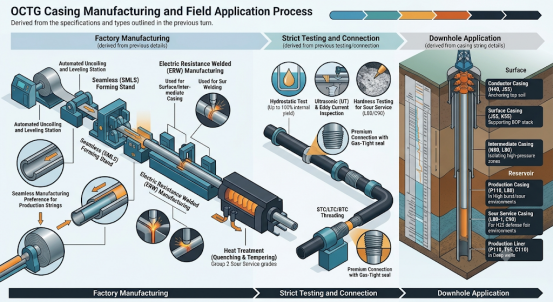
| Manufacturing Process | Seamless (SMLS) or Electric Resistance Welded (ERW) | Seamless is highly preferred for critical production strings while ERW is common for surface coating. |
| Connection Types | • STC (Short Thread Coupled) | BTC offers superior tensile strength. Premium connections are mandatory for high-pressure gas or horizontal walls. |
| • LTC (Long Thread Coupled) | ||
| • BTC (Butter Head Coupled) | ||
| • Premium Connections (Gaslight, metal-to-metal seal) | ||
| Product Specification Level | PSL1, PSL2, PSL3 | Defines increasing levels of stiffness in quality control, chemical verification, and non-destructive testing. |
| Essential Testing | • Hydrostatic Testing (up to 100% internal yield) | Ensures zero failure probability against high tensile, collapse, and burst forcesdownhole. |
| • Ultrasonic (SIT) & Eddy Current Inspection | ||
| • Changy V-Notch Impact Testing | ||
| • Hardness Testing (critical for L80/C80 source service) | ||
Standard:
| OCTG Casing Types by Well Section & Steel Grades | |||
| Casing Type / Section | Typical OD Range | Common Steel Grades | Downhole Primary Function |
| Conductor Casing | 16" to 20" | H40, J55, K55 | The outermost ring, driven into the ground to prevent the top soil/unconsolidated formations from collapsing during initial drilling. |
| Surface Casing | 10-3/4" to 13-3/8" | J55, K55, N80 | Protects shallow freshwater sends from contamination, supports the blowout preventer (BOP) stack, and anchors later springs. |
| Intermediate Casing | 7" to 9-9/8" | N80, L80, P110 | Isolates abnormally high-pressure zones, lost circulation formations, or undatable salt layers before reaching target depth. |
| Production Casing | 4-1/2" to 7" | P110, L80, C90, Q125 | The final ring running into the oil/gas reservoir. Must withstand maximum internal burst pressures and sour corrosion environments. |
| Production Liner | 3-1/2" to 5-1/2" | P110, T95, C110 | A ring that does not extend to the surface, but hangs from the intermediate casing to minimize steel costs in deep wells. |
| Sour Service Casing | Varies by section | L80-1, C90, T95, C110 | Specifically processed with controlled hastness and fine microstructure to resist Hydrogen Induced Cracking (HC) in HQS environments. |
Process:
Packing: